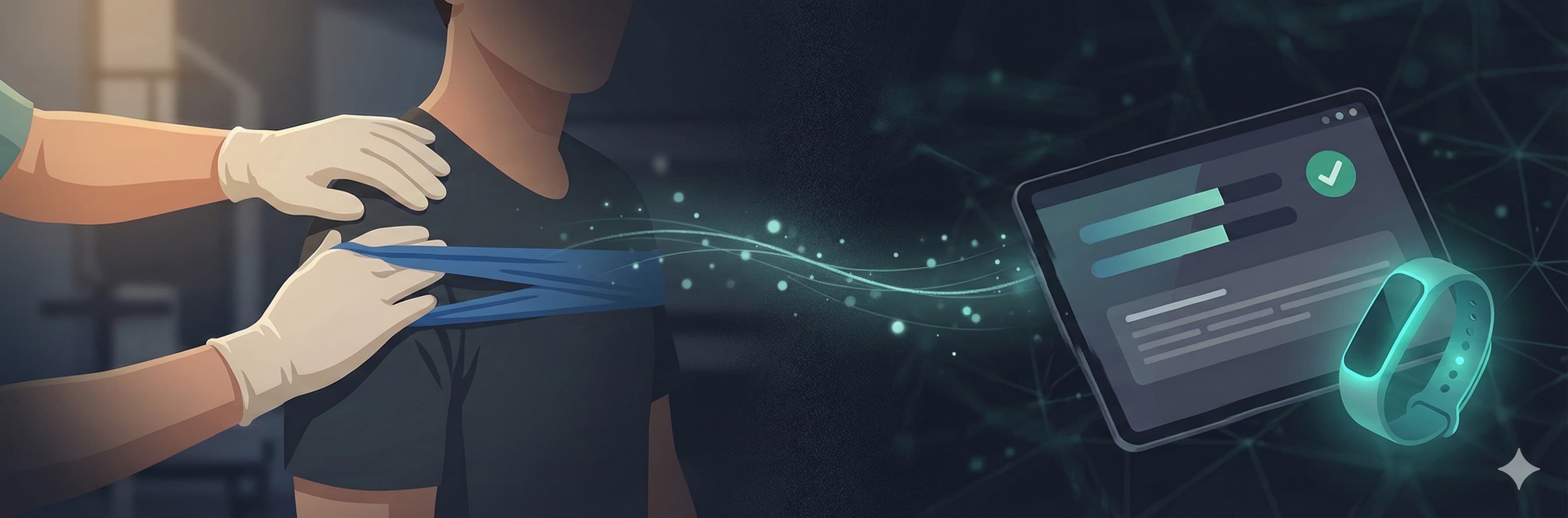
The Other 90-Day Blind Spot
A patient undergoes rotator cuff repair. The surgeon sees them for 15 minutes at the 6-week mark. The physical therapist works with them two or three times a week for six weeks. Then — nothing. The patient goes home and recovers alone.
The critical recovery window is months two through six. This is when tissue is remodeling, when adherence to exercise protocols determines long-term outcomes, and when patients are most likely to either overdo it or stop doing their exercises altogether. During this period, nobody is watching.
We wrote about this blind spot from the sensor perspective — how implantable sensors can detect mechanical failure before it becomes visible on imaging. But there is an equally important blind spot on the rehabilitation side: we have no continuous visibility into how patients are actually recovering at home.
The Evidence: Remote Monitoring Works
The research is clear. A systematic review of 51 studies found that virtual physical therapy delivers outcomes comparable to in-person therapy for pain, function, and quality of life across musculoskeletal disorders[1]. This is not a niche finding — it is a robust, replicated conclusion.
The numbers from individual studies are striking:
- 92% of arthroplasty patients found remote monitoring technology easy to use[2]
- 94.5% would recommend it to other patients undergoing the same procedure[2]
- 95-97% data compliance with wearable sensors, far exceeding patient-reported outcome questionnaire compliance[3]
Machine learning models can now predict a patient's treatment response as early as session 7[4] — enabling care teams to adjust rehabilitation protocols before problems compound, not after.
A randomized controlled trial provides even more direct evidence: among 52 fast-track total knee arthroplasty patients, those using an interactive telerehab platform showed significantly higher exercise adherence (p=0.002) and greater quadriceps strength (p=0.028) compared to standard care[5].
The question is no longer "does remote monitoring work?" The evidence says it does.
April 2026 update: The evidence has strengthened further. A new meta-analysis of 25 RCTs covering 4,402 patients found that telerehab is now significantly superior to traditional in-person rehabilitation in pain, passive flexion, quadriceps strength, and cost[6]. It is no longer "just as good" — it is better. See our full analysis.
The Surprise: 83% Want Both
Here is what most people get wrong about digital health. They assume the future is either fully digital or fully in-person. Patients disagree.
In a study of 166 patients who had undergone hip or knee arthroplasty, 83% preferred a hybrid model — combining in-person clinical touchpoints with daily digital monitoring at home[2]. Even among patients who felt digital rehabilitation could fully replace in-person therapy (85.4% of total hip arthroplasty patients), most still preferred the combination.
Why? Because patients want two things simultaneously: the reassurance that comes from face-to-face clinical assessment, and the convenience of not having to visit a clinic every time they do their exercises.
This is not "replace the physical therapist." It is "extend the physical therapist's reach into every day the patient recovers at home."
What the Technology Looks Like Today
Digital rehabilitation is no longer a concept — it is a multi-billion-dollar market with mature solutions already in clinical use:
- Wearable sensors + smart implants: Zimmer Biomet's Persona IQ smart knee embeds sensors directly inside the implant, pairs with an Apple Watch for gait tracking, and uses a WalkAI algorithm to predict patients who are falling off their recovery curve. It is the only FDA-cleared smart orthopedic implant on the market.
- AI motion capture: SWORD Health (valued at $4 billion) uses a tablet-based sensor with computer vision to correct patient form in real time. MedBridge launched a phone-camera-only solution in 2025, using AI to assess movement without additional hardware.
- Full surgical journey management: Force Therapeutics and moveUP focus on the entire care arc from pre-op to post-op, with risk stratification, smart alerts, and personalized daily exercise prescriptions. moveUP's clinical data shows an average engagement of 83 days, with 77% of patients completing the full program.
- Scaled platforms: Hinge Health (public company) covers the entire MSK care continuum — prevention, acute injury, chronic pain, and post-surgical rehabilitation — serving millions of members primarily through an employer-paid model.
But these platforms share one fundamental limitation: they measure motion at the skin, not forces at the tissue. A wearable can tell you that a patient raised their arm to 120 degrees, but it cannot tell you what force that motion placed on the repair site. Even Persona IQ, the most advanced smart implant available, measures joint kinematics (acceleration, angular velocity) rather than direct tissue-interface pressure. More critically, these active sensor systems require batteries (Persona IQ's battery lasts approximately 10 years) and can only be used in large joint replacements — soft tissue repairs (rotator cuff, ACL reconstruction) have no equivalent solution today.
This is where the bridge between passive implantable sensors and rehabilitation technology becomes critical. When a battery-free LC sensor inside the implant directly measures tissue forces, and a wearable outside measures the motion that caused those forces — the rehabilitation system has both halves of the picture. And this time, small enough for a rotator cuff, not just an artificial knee.
Where iRehab Fits
iRehab is De Novo Orthopedics' approach to this problem. Unlike consumer wellness platforms, it is designed around the surgeon's clinical workflow:
- Guided exercise prescriptions — auto-generated personalized exercise plans based on post-surgical phase, split into morning and evening sessions with 4 exercises per page, micro-progress tracking, and completion celebrations to reduce cognitive load for patients aged 60-80
- PROM functional scoring — built-in PROMIS Global-10 instrument collected via QR code or link, with automatic Physical and Mental Health T-score calculation so surgeons can track functional recovery trends over time
- Recovery milestone reports — automated structured reports at key post-operative timepoints (day 3, 7, 14, 30) with pain trend charts and photo comparisons, delivered to the surgeon's inbox without requiring a login
- Photo-based documentation — wound healing progress and range of motion captured visually over time
- Pain score tracking — correlated temporally with specific exercises to identify which movements cause problems
- Surgeon-facing dashboards — structured data with one-tap LINE sharing, so the surgeon can review everything in minutes, not raw data dumps
The future vision connects directly to our implant technology. When Discovery R's traffic light feedback system produces real-time pressure data during rehabilitation, that data flows into the same platform the surgeon already uses. The "green/yellow/red" signal from the sensor becomes a rehabilitation tool — telling the patient and the PT not just whether an exercise was completed, but whether it was safe.
The Hybrid Standard
The field has moved past the question of effectiveness. Systematic reviews across shoulder, hip, and knee rehabilitation all point the same direction: remote monitoring and virtual rehabilitation produce outcomes comparable to in-person care.
The remaining question is implementation: how do we integrate remote monitoring into clinical practice without increasing clinician burden?
The answer is the hybrid model that 83% of patients already want. The surgeon stays in control. The patient gets daily support. Data fills the gap between clinic visits. And when the data comes not just from a wristband but from inside the implant itself, the blind spot disappears entirely.
For more on how implantable sensors enable this vision, read The Sentinel Inside the Bone.
References
-
Suhr YT, et al. The Role of Virtual Physical Therapy in the Management of Musculoskeletal Patients. Curr Rev Musculoskelet Med. 2025;18(4):109-118. PubMed
-
Booth RE, et al. Patients' Perceptions of Remote Monitoring and App-Based Rehabilitation Programs After Total Joint Arthroplasty. J Arthroplasty. 2023;38(9):1845-1851. PubMed
-
Yocum DE, et al. Patient-Reported Outcomes Do Not Correlate to Functional Knee Recovery and Range of Motion After Total Knee Arthroplasty. J Orthop Case Rep. 2023;13(08):3844. PubMed
-
C R, et al. Predicting Pain Response to a Remote Musculoskeletal Care Program for Low Back Pain. J Med Internet Res. 2024;26:e64806. PubMed
-
Nuevo R, et al. Telerehabilitation Following Fast-Track Total Knee Arthroplasty Is Effective and Improves Exercise Adherence and Quadriceps Strength. Disabil Rehabil. 2024;46(13):2834-2841. PubMed
-
Efficacy of telerehabilitation for total knee arthroplasty: a meta-analysis based on randomized controlled trials combined with a bibliometric study. 25 RCTs, 4,402 patients. PubMed