It started with a complaint
Brief did not start with families.
A few months ago, when our co-founding physician was invited to give a talk, a senior orthopedic surgeon told him about a problem. After his hospital brought in AI to help write medical records, the notes had grown so long that no one could read them. There were more words, but doctors did not understand the patient in front of them any better.
Our answer was to work in the other direction. Instead of letting AI make the record longer after the visit (we wrote about this kind of over-generation in Intake Compression, Not Form Consolidation), let patients say what matters most, in their own words, before the visit: where it hurts, when it started, what worries them, what they most want to ask. The doctor has read those few lines before the patient sits down.
That is Brief (design details in First-Visit Brief: When the Patient Can't Name the Tissue). It began as a way to solve a doctor's problem.
A scene we kept seeing
After Brief went live, one scene kept coming up in clinic (what follows is a composite of many visits, not any single patient):
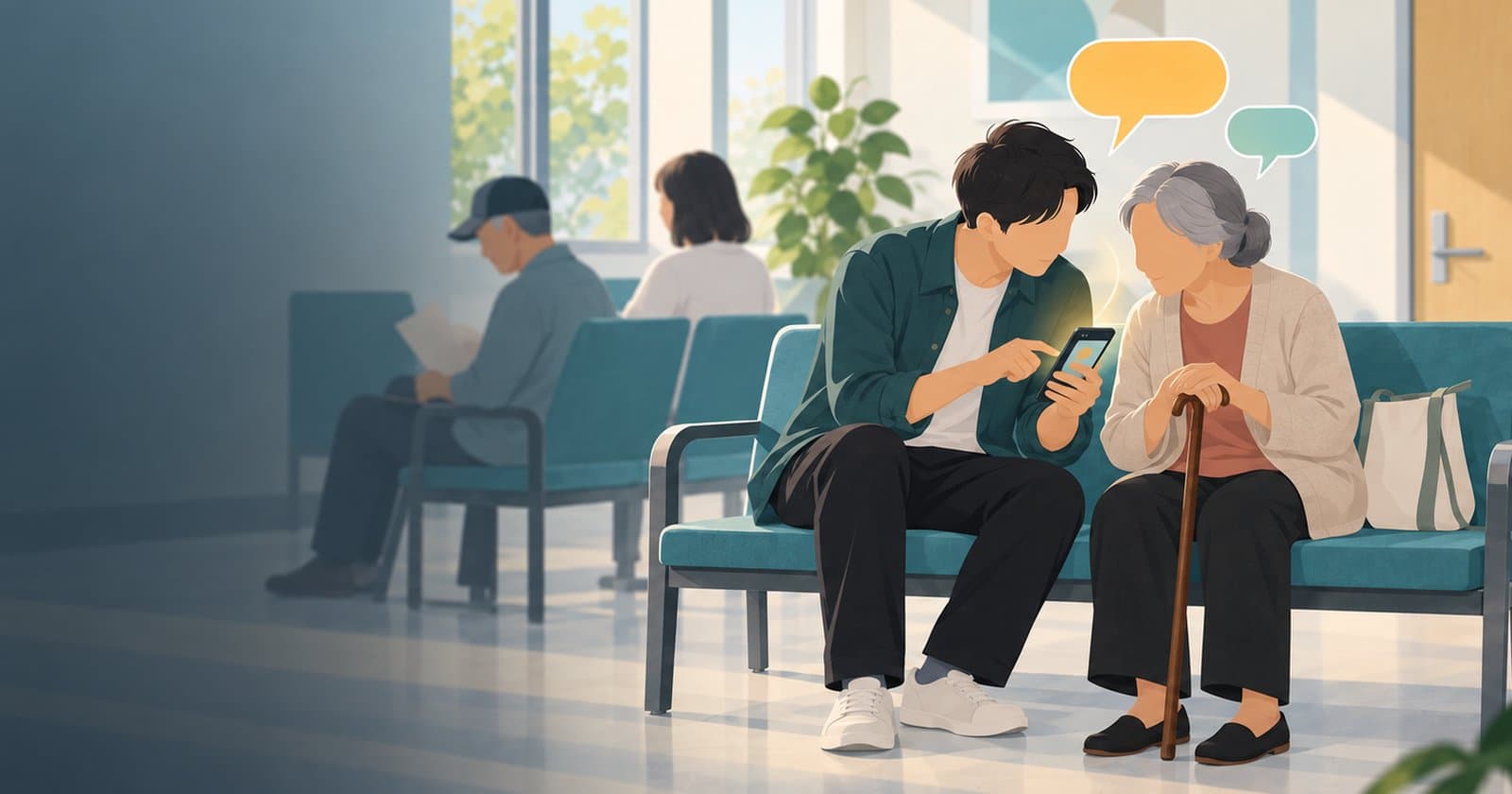
A grandmother in her eighties sits in the waiting area. Her grandson, next to her, holds a phone and reads each question out loud, then types in her answers. Sometimes, halfway through, he adds something of his own: "She's been waking up at night from the pain. She just doesn't mention it."
At that point, the words in the Brief come from two people working together: the patient speaks, a family member types, and sometimes the family member adds what they have noticed.
Looking back, we had assumed a family member was there all along. Every option in Brief has to pass the same test before it goes live: could a family member with no medical background answer it without looking anything up? But we treated the family as a standard to design against, not as the person actually filling it in.
We had pictured Brief as a line between patient and doctor. In practice, a family member often stands in the middle of that line.
What "the patient's own words" means now
Brief's central principle is this: the patient's own words are heard before the visit, and they are never rewritten. It is why translations are stored separately and never overwrite the original.
But when a family member fills it in, the doctor needs to know: is this sentence something the patient said, or something the family member observed?
Both are valuable, and they often complement each other. The patient says "it's fine, not too bad." The family member says "he wakes up at night in pain." Both are true, and the doctor needs to see both. Today, Brief cannot show which sentence came from whom.
Where we want to go next
These are directions we are planning. None of them is live yet, and the order may change:
- Know who is filling it in. Ask one question at the start: is this being filled in by the patient, or by a family member on their behalf, and what is the relationship? It is the smallest possible step, and it gives us data for the first time on a basic question: how many patients fill in Brief with a family member beside them?
- Give the family's observations their own place. What family members see, such as waking at night, frequent falls, or growing forgetfulness, should have its own space, stored separately from the patient's own words, so the doctor can tell them apart at a glance.
- Let caregivers take part in their own language. In Taiwan, many older people are looked after day to day by live-in caregivers from abroad, and the person who sees how an elder is doing every day is not always the family member who comes to clinic. Brief already works in eight languages on the patient side, including Vietnamese, Indonesian and Thai. In the future, it may let caregivers tell the doctor what they see, in the language they know best.
- After the visit, let the family know the next steps too. Many adult children cannot take time off to come along. If the key points and next steps from the visit could also reach them, care would not break down at "Grandpa came home and couldn't clearly explain what the doctor said." It is the same line of thinking we follow in post-operative care (see From Individual Tracking to Family Recovery Coordination).
What we will be careful about
Family involvement sounds good in every case, but we know it is not that simple:
- What the patient can decide, the patient decides. An older person who is fully able to decide for themselves has the right to choose what their family knows and what they don't. A family member filling in the form does not mean the family gets to see everything. This is our standing position on patient data (see Patient-Mediated Continuity for Post-Discharge Health Data).
- Family members are not always acting in good faith. In a small number of cases, the person who comes along is the one who hurt the patient, or who keeps them from speaking. The design has to leave room for the patient to speak alone.
- Consent on someone's behalf has to be clear. Who may fill in for a patient, and who may receive the results of a visit, both involve personal data and consent. These have to be settled in the design, not patched in after launch.
All of this will be written into the specification before any of it is built.
Why family
Every tool De Novo Orthopedics builds comes back to the same thing.
In post-operative care, we see it again and again: patients want to recover faster, and often not for themselves but for their family. They want to get back to picking up their grandchildren, to walk into their daughter's wedding on their own, to stop their son from having to keep taking leave. In Taiwan, rehabilitation has never been a one-person affair; after surgery, it is the family who does the caring. The same idea runs through our disaster-preparedness app: Start With Your Household, Then Watch What Runs Out. And families want to help, but the medical process has never really had a place for them.
Brief started with a complaint, and it was meant to save doctors time. But the grandson holding that phone reminded us: explaining what is wrong has always been something a family often does together. We want Brief to recognize that, and to be designed for it properly.
Related: The Patient Writes in Their Language, the Doctor Reads in Theirs · Fill This Before You See the Doctor: A Patient & Family Guide · From Individual Tracking to Family Recovery Coordination