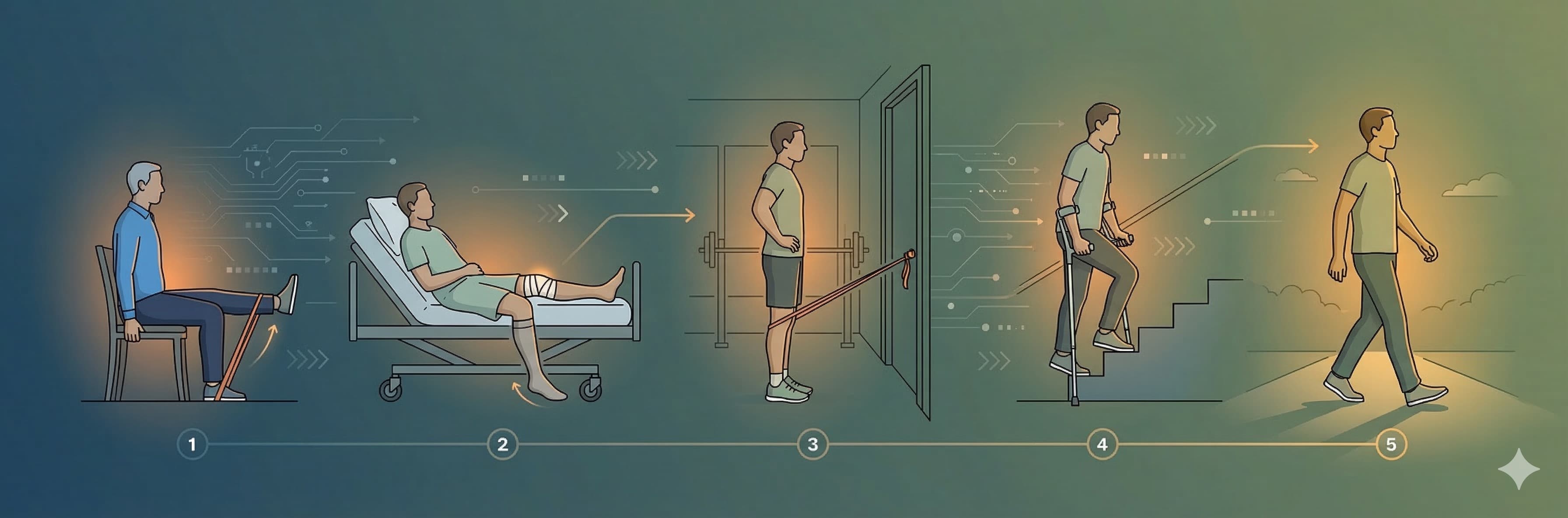
The Protocol Nobody Follows
Every orthopedic textbook describes a phased rehabilitation protocol for total knee arthroplasty. Phase 1: acute recovery. Phase 2: ROM restoration. Phase 3: strengthening. The phases are well-defined, the exercises are evidence-based, and the expected timelines are clear.
The problem is execution. A systematic review of 22 randomized controlled trials found that fewer than 50% of patients complete their prescribed home exercise programs after TKA[1]. The dropout curve is steepest between weeks 3 and 6 — precisely when tissue remodeling demands consistent loading.
This is not a knowledge gap. Patients know they should do their exercises. It is a systems gap. The protocol lives in a paper handout that goes into a drawer. The exercises are demonstrated once, in a clinic, and then the patient is alone with their pain.
We built iRehab's Recovery Engine to close this gap — not by replacing physical therapists, but by encoding their clinical logic into a system that delivers the right exercises, at the right time, every day.
The 5-Phase Model
iRehab's protocol follows the standard clinical phases for TKA rehabilitation, mapped to 34 discrete exercises across 5 phases:
Phase 0: Prehab (8 exercises)
Before the surgery happens. Quad strengthening, hamstring flexibility, and range-of-motion optimization. The evidence is clear: patients who enter surgery with stronger quadriceps recover faster. A meta-analysis of 35 RCTs found that prehabilitation significantly improves early postoperative function and reduces pain scores[2].
Exercises include: quad isometrics, seated knee extension, standing hip abduction, ankle pumps, straight leg raises, heel slides, wall squats, and standing hamstring curls.
Phase 1: Acute Recovery (10 exercises, Day 0–14)
The goal is not performance — it is tissue protection plus early mobilization. Ankle pumps prevent deep vein thrombosis. Quad sets maintain the neuromuscular connection. Gentle ROM exercises prevent arthrofibrosis.
Frequency: 2 sessions per day (morning + evening), 4-5 exercises per session.
The system automatically splits the 10 exercises into two sessions based on time of day. This is deliberate: asking a patient in acute pain to complete 10 exercises in one sitting is a recipe for skipping the whole session.
Phase 2: Subacute (10 exercises, Week 2–6)
ROM restoration is the priority. The target is 0° extension and 110-120° flexion by week 6. Progressive resistance begins with bodyweight and theraband.
New exercises added: step-ups, wall slides, prone knee flexion, seated hamstring curls, mini squats.
Phase 3: Strengthening (8 exercises, Week 6–12)
Functional strength training. The exercises shift from open-chain isolation to closed-chain functional movements: deeper squats, lateral step-ups, single-leg balance, stair training.
Phase 4: Return to Function (6 exercises, Week 12+)
Single-leg work, recreational activities, and self-management. The goal is independence — the patient should no longer need the system for guidance.
Why Phase Governance Matters
Here is what most digital rehabilitation platforms get wrong: they auto-advance patients through phases based on time. "Week 6 → Phase 3. Congratulations."
This is clinically dangerous. A patient who has not achieved adequate ROM by week 6 should not be doing deep squats. Time is a proxy, not a criterion.
iRehab never auto-promotes. Phase advancement requires an explicit clinical decision. The surgeon or physical therapist evaluates ROM, pain levels, swelling, and adherence — then advances the phase manually. The system records who made the decision and when, creating an audit trail.
This design reflects a core principle: the system should encode clinical logic, not replace clinical judgment.
Adaptive Sessions: Morning and Evening
A common failure mode in home exercise programs is session length. A protocol that prescribes 8-10 exercises in a single session assumes the patient has the pain tolerance, time, and motivation to complete them all at once. Most 70-year-old TKA patients do not.
iRehab splits each phase's exercises into morning and evening sessions. The split is frequency-aware:
- 2x/day exercises (e.g., quad sets, ankle pumps): appear in both sessions
- 1x/day exercises (e.g., step-ups, wall slides): appear in one session only
- Time-of-day filtering: opening the app at 7 AM shows the morning session; at 7 PM, the evening session
The patient can override this — a toggle lets them switch to the other session if their schedule changes. But the default is a manageable 4-5 exercises per session, not 10.
Skip-With-Reason: Data the Protocol Cannot See
When a patient skips an exercise, most systems record a binary: done or not done. iRehab asks why:
- Pain-related — the exercise caused or worsened pain
- Physical limitation — fatigue, lack of equipment, or physical constraint
- Scheduling — time conflict or daily routine disruption
- Other — free text for anything the categories do not cover
This data is invisible in traditional rehabilitation. A PT sees a patient three times a week and asks "how are you doing?" The answer is always "fine." But the skip-reason data tells a different story:
- If a patient consistently skips prone knee flexion due to pain, the PT knows to investigate ROM restrictions.
- If a patient skips evening sessions due to fatigue, the PT might reduce evening load and increase morning load.
- If all skips are "busy," the problem is scheduling, not the protocol.
Skip reasons turn compliance data into clinical intelligence.
Progress Tracking for Clinicians
The surgeon sees a dashboard — not a spreadsheet. Each patient row shows:
- 7-day adherence percentage with a visual bar
- Latest VAS pain score with trend direction
- Current phase and days post-op
- Alert indicators: red border for low adherence, orange for rising pain trend, gray for prolonged inactivity
This lets a surgeon scan 30 patients in under a minute and focus attention on the 3 who need it.
The Gamification Question
We deliberately avoided leaderboards, points, and badges. Our patient population is 60-80 years old. They are not motivated by gamification mechanics designed for 25-year-olds.
Instead, we use what we call micro-reinforcement:
- A progress bar that advances when you complete an exercise, read instructions for the first time, or report your pain score — each small action counts
- Haptic feedback (a subtle vibration) on exercise completion
- A streak counter showing consecutive days with at least one completed session
- Milestone celebrations — full-screen messages triggered by recovery achievements (first exercise completed, consistency streaks, phase advancement) and key post-operative milestones
These are small, frequent, and earned. They respect the patient's intelligence without patronizing them.
What This Changes
The Recovery Engine does not replace physical therapists. It fills the 23 hours per day when the PT is not there. It gives patients a structured daily routine that adapts to their schedule and tolerance. It gives clinicians data they have never had before — not just "did the patient exercise?" but "which exercises, when, and why did they skip the ones they skipped?"
Most importantly, it makes the protocol real. Not a handout. Not a one-time demonstration. A daily companion that meets the patient where they are.
iRehab's Recovery Engine is live in clinical settings. For information about clinical partnership or research collaboration, contact us.