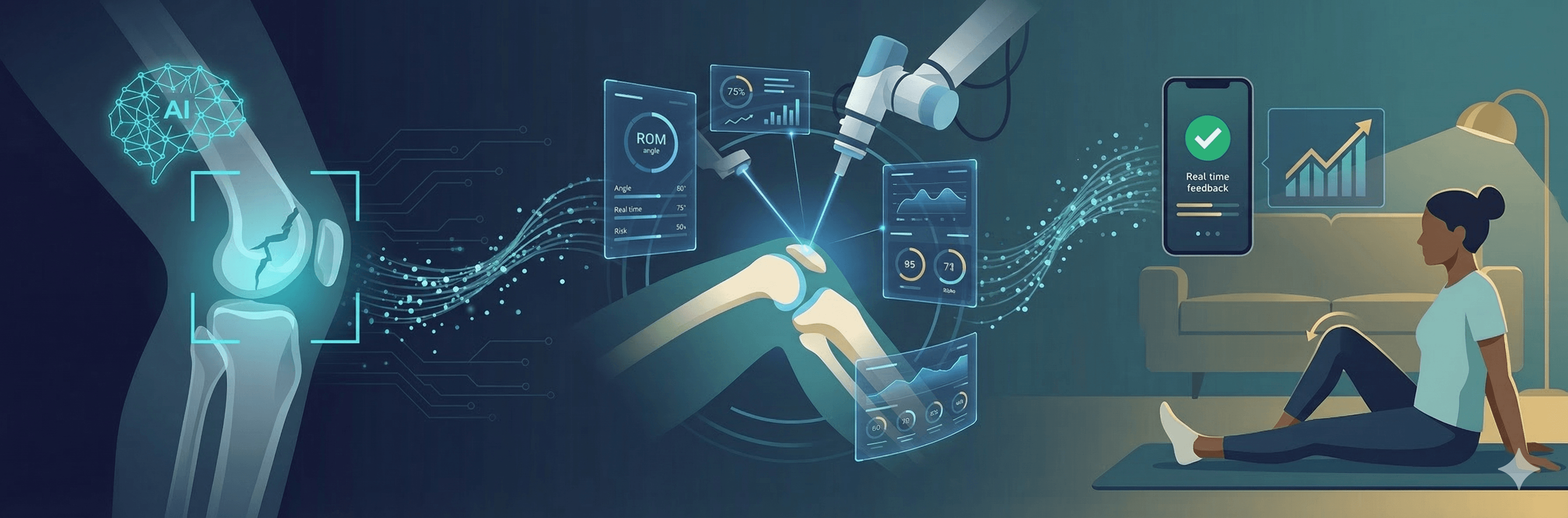
Not the Future — the Present
In 2025, the US FDA cleared 295 AI/ML-enabled medical devices — the highest single-year total in history. As of March 2025, over 1,000 AI devices have received market authorization, with 97% cleared through the 510(k) pathway.
But these numbers hide an imbalance: 76% are concentrated in radiology. Only about 5% relate directly to orthopedics.
This doesn't mean orthopedics doesn't need AI. It means orthopedic AI has enormous whitespace waiting to be filled. And the most critical area isn't inside the OR — it's after the patient goes home.
Before Surgery: AI Is Already Changing Surgical Planning
Imaging and Diagnosis
AI achieves 98% accuracy in fracture detection, including occult fractures that are difficult for conventional methods. Multiple FDA-cleared products are already in clinical use.
3D Surgical Planning
AI can convert standard X-rays into 3D reconstructions in minutes — a process that previously took days or weeks. Surgeons visualize patient-specific anatomy from multiple angles and determine optimal implant size and positioning before making an incision.
Zimmer Biomet's ROSA Knee with OptimiZe technology is the industry's only FDA-cleared robotic system with AI-powered automated kinematic alignment.
Preoperative Risk Prediction
This is the most exciting frontier. Machine learning models can now predict surgical outcomes before the operation:
- Patient satisfaction: A biopsychosocial ML model trained on 5,720 knee OA patients achieves AUC of 0.888 (KSS), 0.836 (SF-PCS), 0.806 (OKS) for predicting two-year dissatisfaction[1]
- Who won't benefit: Another model specifically identifies patients unlikely to benefit from TKA[2]
- Complication risk: XGBoost models predict major complications with AUC of 0.68
The top four predictors: preoperative functional score, age, comorbidity count, and preoperative mental health status.
What does this mean? If you collect PROMs (Patient-Reported Outcome Measures) before surgery, you have the most important input data for ML prediction. Risk stratification no longer waits until something goes wrong postoperatively — it begins before the operation.
During Surgery: Robotic Assistance Is Maturing
Surgical robots aren't new, but AI is making them smarter:
- Real-time feedback: Intraoperative bone cut precision correction
- Personalized alignment: Automatic implant angle adjustment based on patient-specific anatomy
- Learning curve compression: AI assistance reduces surgical variability, helping younger surgeons reach senior-level consistency faster
But surgery itself accounts for only half the outcome. The other half is rehabilitation.
After Surgery: The Real Battleground
This is orthopedic AI's biggest opportunity — and its most neglected arena.
Computer Vision: Your Phone Becomes a Motion Lab
Phone-camera-based pose estimation (MediaPipe Pose, YOLO Pose) now achieves near-clinical accuracy:
- Compensatory movement detection: >98% accuracy[3]
- Range of motion (ROM) measurement: 89% accuracy
- Latency: <100ms, sufficient for real-time feedback
SWORD Health ($4B valuation; acquired Kaia Health for $285M in January 2026) uses tablet sensors paired with computer vision for rehab movement feedback. MedBridge launched a phone-camera-only solution in 2025 — no additional hardware required.
Open-source solutions like OpenCap are pushing smartphone motion capture quality toward lab-grade systems.
Outcome Prediction: Intervening Before Problems Escalate
ML models can predict a patient's treatment response by their 7th physical therapy session[4] — giving care teams the ability to adjust protocols before problems worsen.
Wearable sensor data is also evolving. A 2026 systematic review found that wearables improved bone stimulation tracking by 52% and impact load tracking by 371%[5]. Ankle-worn IMUs can measure limb load asymmetry — a key indicator for predicting recovery divergence.
Fall risk prediction is another breakthrough: ML models using wearable sensor data from functional performance tests can predict fall risk in total hip arthroplasty patients.
Smart Implants: From Motion to Force
Zimmer Biomet's Persona IQ is the only FDA-approved smart orthopedic implant. Its Canturio Tibial Extension wirelessly transmits daily gait dynamics: steps, walking speed, ROM, cadence, and stride length.
A 150-patient clinical study (2023-2025) showed that sensor-measured ROM strongly correlates with in-office measurements[6]. Combined with WalkAI algorithms, the system predicts which patients are recovering well and which need additional attention. Patients using Persona IQ with a care management platform showed better one-year outcomes than those with conventional implants.
But Persona IQ has two fundamental limitations:
- It requires a battery (~10-year lifespan) — limiting it to large joint replacements
- It measures motion, not force — acceleration and angular velocity tell you how the knee moves, but not how much stress the tissue interface bears
This is why passive implantable sensors represent the next frontier. Battery-free LC resonant sensors measure tissue forces directly, unconstrained by implant size — making them viable for rotator cuff repairs and ligament reconstructions where Persona IQ cannot go.
From Tools to Systems: The Value of Full-Stack AI
The market doesn't lack AI tools. What it lacks is the ability to connect tools into systems.
An isolated CV motion recognition app can tell a patient "your knee bends to 110 degrees." But it can't tell you:
- How much has this angle improved compared to last week? (requires PROM time-series data)
- How much force does this movement generate at the repair site? (requires sensor data)
- Is this patient's recovery trajectory diverging from the expected curve for this surgery type? (requires ML prediction models)
- Does the surgeon need to intervene now? (requires clinical decision support)
The real value isn't any single AI model's accuracy — it's the completeness of the data flow.
This is De Novo Orthopedics' strategy: implant sensors (tissue forces) + wearables (motion data) + PROMs (patient experience) + ML (prediction and alerts) → flowing into the same platform surgeons already use (iRehab).
The goal isn't to build the best version of every AI capability. It's to deliver the right data, at the right time, to the right person.
The Market: A 32% CAGR High-Speed Lane
| Market Segment | 2024-2025 | Projected | CAGR |
|---|---|---|---|
| AI Orthopedic Imaging | $1.63B | $7.14B (2029) | 34.2% |
| AI Orthopedic Surgery | $307.6M | $2.74B (2032) | 32.0% |
| Smart Orthopedic Implants | $28.8B | $38.3B (2030) | 5.9% |
| Digital MSK Care | $44.35B | $116.39B (2030) | 17.7% |
AI-specific segments are growing at 30-34% CAGR — six times faster than traditional orthopedic devices (5-6%). The signal is clear: value is shifting from hardware to data and software.
But this doesn't mean hardware doesn't matter — quite the opposite. When software becomes ubiquitous, unique data sources become the real moat. Tissue-level force data from implantable sensors is something no phone app or wearable can replicate.
AI Won't Replace Orthopedic Surgeons
Every conversation about AI in healthcare triggers the same question: "Will AI replace doctors?"
In orthopedics, the answer is unambiguous: No.
AI can detect 98% of fractures. But deciding whether to operate, what approach to use, and how to manage postoperative care — these judgments require more than pattern recognition. They require clinical experience, patient communication, and an understanding of individual variation.
What AI actually changes: it gives surgeons the right information at the right time.
Before surgery: ML models reveal where this patient's risks lie. During surgery: robots help cut more precisely. After surgery: sensors and PROMs report continuously between clinic visits.
The surgeon remains the decision-maker. AI is the tool that makes those decisions better — provided the data is collected, integrated, and delivered.
To understand why CMS now mandates PROM collection, read Why Your Surgeon Should Be Tracking PROM. To learn how the 90-day rehabilitation blind spot gets filled, read 83% of Patients Want Both.
References
-
Biopsychosocial ML models predict improvement after TKA. Scientific Reports. 2025. Nature
-
Pua YH, et al. Identifying who won't benefit from TKA using ML. npj Digital Medicine. 2024. Nature
-
Towards Intelligent Assessment in Personalized Physiotherapy with CV. Sensors. 2025. PMC
-
Predicting Pain Response to Remote MSK Care. J Med Internet Res. 2024;26:e64806. PubMed
-
Wearable Sensor Technologies Systematic Review. JMIR mHealth. 2026. JMIR
-
Persona IQ Smart Implant Data Correlates to In-Office ROM. ScienceDirect. 2026. Link