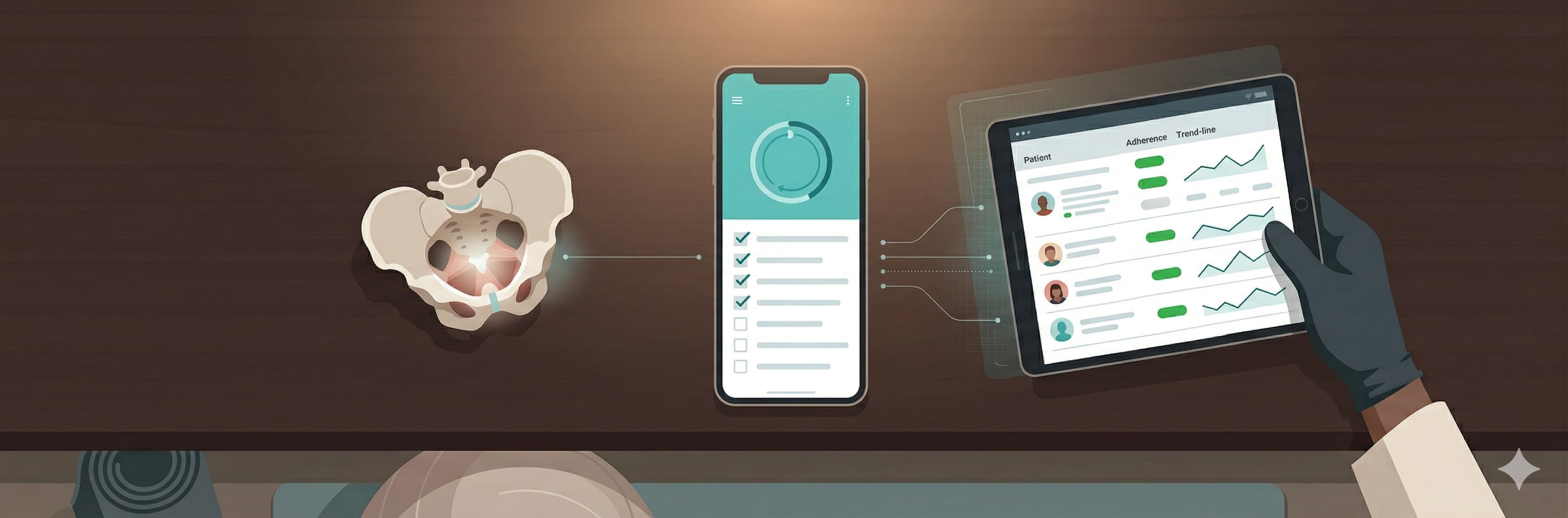
An Underserved Rehabilitation Domain
Pelvic floor dysfunction affects approximately one-third of women globally. Stress urinary incontinence, pelvic organ prolapse, urgency incontinence — these conditions severely impact quality of life, yet most patients never receive systematic pelvic floor muscle training.
"Do your Kegels" is the most commonly prescribed exercise. But most patients are unsure they are doing it correctly. Research shows that up to 50% of women cannot correctly contract their pelvic floor muscles without instruction — they bear down with their abdominals or glutes instead of engaging the pelvic floor.
This is not the patient's failure. It is a failure of delivery. A single instruction to "do Kegels at home" — without a structured schedule, progressive training plan, or tracking mechanism — is no different from handing a paper exercise sheet to a post-surgical patient and hoping for 12 weeks of compliance.
iRehab's pelvic floor rehabilitation module was designed to close this gap.
7 Evidence-Based Pelvic Floor Exercises
1. Kegel Exercise — Slow Twitch
Goal: Train slow-twitch fibers for sustained support
Contract the pelvic floor muscles as if stopping urination or holding gas. Do not move the abdomen, thighs, or buttocks. Hold the contraction, then relax. Gradually increase hold time as you progress.
Default: 3 sets x 10 reps, 5-second hold
2. Kegel Exercise — Quick Flick
Goal: Train fast-twitch fibers for cough/sneeze leak prevention
Quickly contract the pelvic floor muscles and immediately release. This trains the fast-twitch fibers needed for the rapid contractions that prevent leakage during coughing, sneezing, or laughing.
Default: 3 sets x 10 reps
3. Pelvic Floor Coordinated Breathing
Goal: Establish breath-floor coordination — the foundation of correct training
Lie down or sit. Inhale and relax the pelvic floor, feeling it gently expand downward. Exhale and gently contract the pelvic floor. This breath-floor coordination is the starting point for all correct pelvic floor training.
Default: 3 sets x 10 reps
4. Bridge with Pelvic Floor Engagement
Goal: Integrate pelvic floor contraction into functional movement
Lie with knees bent, feet hip-width apart. Contract the pelvic floor first, then slowly lift hips off the bed. Hold at the top, maintaining pelvic floor contraction and normal breathing. Slowly lower, then release the pelvic floor.
Default: 3 sets x 10 reps, 5-second hold
5. Transverse Abdominis Activation (Core-Floor Link)
Goal: Train core-pelvic floor synergistic contraction
Lie with knees bent. On exhale, gently draw the belly button toward the spine while contracting the pelvic floor. Do not hold your breath or move the lumbar spine. This trains the neural connection between the core and pelvic floor.
Default: 3 sets x 10 reps, 5-second hold
6. Adductor Squeeze with Pelvic Floor
Goal: Enhance pelvic floor awareness through adductor co-activation
Lie with knees bent, pillow or soft ball between the knees. Gently squeeze while contracting the pelvic floor. Hold 5 seconds, release together. The adductors share neural pathways with the pelvic floor — squeezing helps patients "find" the correct muscles more easily.
Equipment: Pillow or soft ball
Default: 3 sets x 10 reps, 5-second hold
7. The Knack (Pre-contraction Technique)
Goal: Stress incontinence prevention — the most important practical technique
Before coughing, sneezing, lifting, or laughing, quickly contract the pelvic floor first. Maintain the contraction until the pressure event is over. This is the single most important functional technique for stress urinary incontinence prevention.
Default: 1 set x 5 reps (integrated into daily life)
4 Clinical Programs
Program 1: Pelvic Floor Prehab (Pre-Surgical)
For: Patients preparing for pelvic floor surgery
Design logic: Establish a pelvic floor strength baseline and correct contraction patterns before surgery. Patients who can correctly contract pre-operatively recover training much faster post-operatively.
Exercise sequence: Coordinated breathing → Slow Kegel → Quick Kegel → TA activation → Bridge → The Knack → Walking
Program 2: Post Anti-Incontinence Surgery (TVT/TOT Sling)
For: Patients who have undergone TVT or TOT mid-urethral sling surgery
Post-op restrictions:
- No lifting >5 kg for 6 weeks
- No straining
- No high-impact exercise
- Kegels only when surgeon clears (typically 2-4 weeks post-op)
Design logic: Early post-op focuses on coordinated breathing and gentle activation. Kegels are added only after surgeon clearance. Exercise parameters (sets, reps, hold time) start reduced and progressively increase with recovery.
Program 3: Post Pelvic Organ Prolapse Repair
For: Patients who have undergone pelvic organ prolapse repair surgery
Post-op restrictions:
- No lifting >3 kg for 6-8 weeks
- No straining
- No intercourse for 6 weeks
- No deep squats
Design logic: Restrictions are stricter than anti-incontinence surgery. Exercise parameters are more conservative with a more gradual progression. Focus is on protecting the repair site while maintaining pelvic floor muscle tone.
Program 4: Pelvic Floor General (Non-Surgical)
For: Patients who need pelvic floor strengthening without surgery
Goals: Strengthen pelvic floor muscles, improve continence, establish core-floor coordination
Exercise combination: All 7 exercises, no restrictions. This is the most comprehensive training program, suitable for patients who need pelvic floor training without surgical contraindications.
System Integration: Same Infrastructure as Orthopedic Rehab
The pelvic floor module is built on iRehab's existing rehabilitation engine — the same technical infrastructure as the TKA five-phase protocol:
- Daily adaptive scheduling — the system arranges daily exercises according to the program; patients open the App and know exactly what to do
- 30-second design principle — every interaction completes in 30 seconds, suitable for all age groups
- Skip-with-reason tracking — when patients skip exercises, the reason is recorded (pain, fatigue, time), giving clinicians data the prescription alone cannot see
- Pain score tracking — daily VAS trend detection, with automatic clinician alerts when anomalies are detected
- PROM functional scoring — periodic PROMIS Global-10 collection to track functional recovery trends
- Surgeon-facing dashboard — all patients' adherence rates, pain trends, and exercise completion at a glance
Why Pelvic Floor Rehabilitation Needs Digital Tools
Pelvic floor rehabilitation faces greater challenges than orthopedic rehabilitation:
- Stigma — many patients are embarrassed to discuss incontinence, let alone practice Kegels in a treatment room
- Invisibility — pelvic floor muscles are internal; unlike knee flexion, you cannot visually observe the exercise
- Lifelong commitment — pelvic floor training is not a 6-week course but a lifelong habit
- Correctness — without feedback, patients cannot confirm they are doing it right
Digital tools address the first three challenges: patients practice at home, not in a clinic; audio cues guide breathing and contraction rhythm; daily scheduling builds long-term habits. The fourth challenge (correctness feedback) is the next step — integration with pressure sensors or biofeedback devices.
iRehab's pelvic floor rehabilitation module is built into the platform. For patient-side operation, see the Patient App Guide. For clinician features, see the Doctor PWA Guide. For clinical partnership, contact us.